

BIGF Joins National Economic Diplomacy Conference, Calls for Digital Governance to Be Central to Bangladesh’s Growth Roadmap

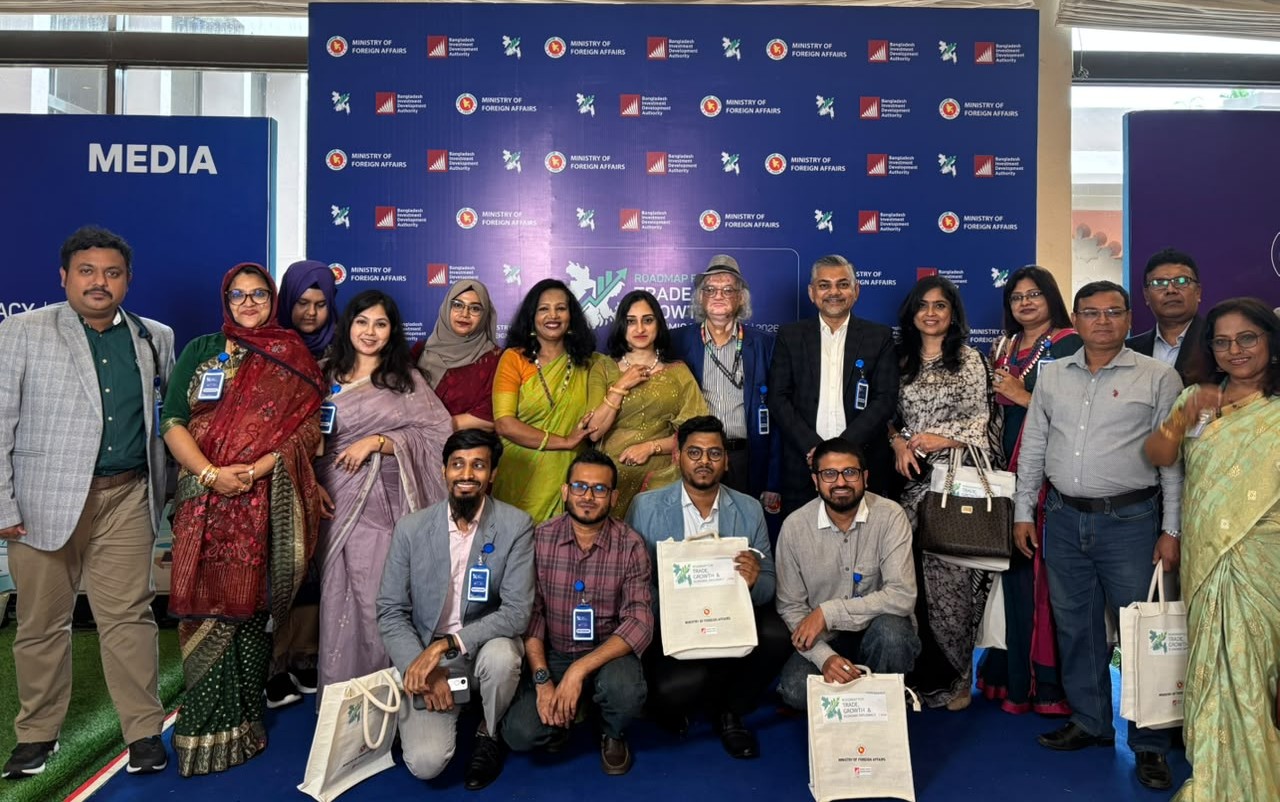
Dhaka, Bangladesh | 15 June 2026
Bangladesh’s next stage of economic diplomacy will be shaped not only by trade, finance and investment, but also by artificial intelligence, digital innovation, creative industries, youth participation and trusted digital governance.
With this message, a 45-member delegation of the Bangladesh Internet Governance Forum (BIGF) participated in the national conference titled “Roadmap for Trade, Growth & Economic Diplomacy: Navigating Risks, Leveraging Resilience,” held on 13 June 2026 at the Pan Pacific Sonargaon Hotel in Dhaka. The conference was organized by the Ministry of Foreign Affairs of the Government of the People’s Republic of Bangladesh, jointly with the Bangladesh Investment Development Authority (BIDA).
The conference brought together senior government officials, Heads of Mission accredited to Bangladesh, development partners, multinational corporations, bilateral and foreign chambers of commerce, national business associations, academics, civil society leaders, youth representatives, and members of the private and technical communities.
The gathering took place at a defining moment for Bangladesh. As the country prepares for a new phase of external economic engagement amid shifting global economic dynamics, geopolitical realignments and the post-LDC graduation transition, the discussions focused on how Bangladesh can strengthen trade competitiveness, attract investment, diversify growth and build long-term resilience.
The conference was designed as a working platform rather than a conventional summit. Its purpose was not only to frame Bangladesh’s economic priorities, but also to convert them into practical propositions for bilateral partners, development agencies, investors, chambers, industries and emerging sectors. The key objective was to clarify Bangladesh’s immediate priorities for 2026 on trade, investment and financing, while identifying targeted diversification tracks that can strengthen resilience beyond traditional sectors.
A central feature of the conference was its three thematic plenary segments.
Thematic One: The Policy Compass — Advancing Trade and Investment focused on Bangladesh’s external economic direction and the policy priorities required to strengthen market access, investment confidence and international cooperation.
Thematic Two: Capital for Growth — Finance, Commerce and Trade addressed financing, tariffs, market access, industrial competitiveness and reform signals needed to improve access to capital and support export-oriented growth.
Thematic Three: The New Stage — Government Policy, AI, Creative Industries and Sport marked a significant broadening of Bangladesh’s economic diplomacy agenda. The session placed artificial intelligence, the digital economy, creative industries and sport at the centre of Bangladesh’s future growth strategy.
Thematic Three included a Special Address by the Hon’ble Adviser to the Prime Minister on Posts, Telecommunications, ICT and Science & Technology, along with interventions by the Hon’ble Minister for Cultural Affairs, the Hon’ble State Minister for Cultural Affairs, and the Hon’ble State Minister for Youth and Sports. The session articulated a forward-looking vision in which emerging sectors are no longer treated as peripheral, but as strategic drivers of productivity, innovation, exports, investment and global visibility.
Key messages from the session included the government’s commitment to positioning AI and the digital economy as transformative pillars of growth; recognition of film, music, content, design, gaming and other creative industries as high-value sectors; and the elevation of sport as a strategic economic sector linked to infrastructure, events, tourism, talent development and soft power.
The discussions also emphasized the need for enabling policies, incentives, institutional support and public-private partnerships to attract domestic and foreign investment into these emerging sectors.
For BIGF, the conference underscored a critical policy message: digital transformation must be supported by inclusive, accountable and people-centered digital governance. Artificial intelligence, digital platforms and emerging technologies can accelerate economic growth, but they also raise urgent questions around trust, data governance, digital rights, cybersecurity, inclusion, youth participation, gender equality and responsible innovation.
“Bangladesh’s economic diplomacy must now include digital diplomacy, AI governance and multistakeholder cooperation as core national priorities,” said BIGF in its message following the conference. “Digital prosperity will be meaningful only when it is inclusive, trusted, rights-based and accessible to all communities.”
The BIGF delegation reflected the organization’s multistakeholder character and included representatives from several affiliated communities. The delegation comprised 3 representatives from the BIGF Executive Committee, 10 representatives from civil society organizations, 6 representatives from the Bangladesh Youth Internet Governance Forum, 3 representatives from the Bangladesh Technical Internet Governance Forum, 2 representatives from the Bangladesh School of Internet Governance, 3 representatives from Bangladesh Academia IGF, 9 representatives from the Bangladesh Women Internet Governance Forum, and 9 representatives from the Bangladesh Kids Internet Governance Forum.
Since its establishment in 2006, BIGF has played an important role in promoting inclusive dialogue on Internet governance, digital policy, digital inclusion and people-centered digital development in Bangladesh. As Bangladesh’s national Internet Governance Forum affiliated with the United Nations Internet Governance Forum, BIGF serves as a collaborative platform bringing together government institutions, civil society, academia, the private sector, the technical community, media, women, youth and children.
The participation of BIGF and its affiliated communities in the conference highlighted the growing recognition that Bangladesh’s future economic resilience will depend not only on market access and investment flows, but also on the quality of its digital governance ecosystem.
As Bangladesh navigates the risks of a changing global economy, BIGF called for stronger coordination among government, private sector, civil society, academia, the technical community, youth and development partners to ensure that AI, digital economy, creative industries and innovation are advanced through transparent, inclusive and accountable policy frameworks.
The conference successfully opened new avenues for partnership with global technology firms, content platforms, cultural institutions, sports organizations, investors and development partners. It also reinforced the importance of building a diversified economic diplomacy agenda that connects trade, finance, technology, culture and human capital.
BIGF urged all relevant stakeholders to take forward the conference outcomes through a practical follow-up mechanism, including policy dialogues, investment propositions, digital governance consultations, youth engagement, and stronger alignment with Bangladesh’s national digital transformation agenda.
Call for Action
BIGF calls on policymakers, development partners, investors, chambers, technology companies, civil society organizations, academia, youth and the technical community to work together to ensure that Bangladesh’s next phase of economic diplomacy is digitally inclusive, innovation-driven and people-centered.
To unlock true resilience, Bangladesh must place digital governance, responsible AI, creative economy, youth innovation and multistakeholder cooperation at the heart of its national growth strategy.